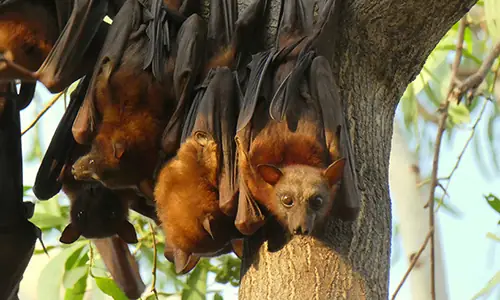
Little Red Flying Foxes and the Australian bat lyssavirus
Little Red Flying Foxes are forest gardeners, spreading pollen and seeds in their search for food. They are also carriers of the Australian bat lyssavirus, a rabies-like virus that is invariably fatal if passed from animal to human.
Little Red Flying Foxes are forest gardeners that prefer to feed on the pollen and nectar of native trees. They will fly up to 50km a night to find food and colonies are nomadic, moving on when food becomes scarce. As they fly, they move pollen on their fur and seeds in their bellies, creating more forests along the way. When they roost, they contribute nutrients to the soil through their droppings, and when their collective weights break tree branches, they create patches of sun on the forest floor, allowing seedlings to reach towards the light.
Flying foxes are essential forest inhabitants and quite beautiful animals that have complex relationships with one another, communicating using a language of many different squarks and gurgles. Unfortunately, while they are cute to watch, Little Red Flying Foxes do not make great neighbours. Many larger garden and street trees such as African Mahogany, Figs or Tamarind provide ideal roosts for many thousands of bats at a time, and the noise they create and smells they produce can be a real headache in suburban areas.
While they may be cute, fuzzy little flappers, it is vitally important that you do not touch the bats!
Like all species of Australian bats, Little Red Flying Foxes may carry the Australian bat lyssavirus. Australian bat lyssavirus (ABLV) and rabies belong to a group of viruses called lyssaviruses. These viruses are usually transmitted via a bite or scratch from an infected animal. They all cause a similar illness known as rabies, which affects the central nervous system resulting in paralysis, delirium, convulsions and death. There have only been 3 human cases of ABLV in Australia, with the first case occurring in 1996 and all cases have died.
Only people who have been vaccinated against rabies and trained in rescue techniques should handle bats.
If you are bitten by a bat of any species, you should first wash the area vigorously with soap and water. If bat saliva enters your nose, eyes or mouth, flush the area for several minutes. Once you’ve washed the area thoroughly, apply an iodine or alcohol-based antiseptic and seek medical attention immediately as post-exposure vaccination is essential.
Australian bats, including Little Red Flying Foxes, are fascinating and essential to our environments, but they may carry ABVL. The only way that you can catch ABVL is if its saliva gets into an open wound such as a bite or a scratch, and the only way that will happen is if you pick up or interfere with the bat.
Protect yourself from Australian bat lyssavirus, never touch bats. If you come across a bat in trouble call your local wildlife rescue service or head to Northern Territory Government website for assistance.