Be Crocwise
Since its inception, Be Crocwise has demonstrated how targeted, locally tailored safety programs can effectively support communities to live alongside wildlife while minimising risk. In Australia, the campaign brings together decades of experience and learning. In recent years, national and international agencies have developed programs tailored to their own contexts.
Living with crocodiles is an integral part of life in northern Australia. Since 2009, the Be Crocwise safety education campaign has played a vital role in reducing human–crocodile conflict across crocodile habitats.
Saltwater (estuarine) crocodiles present both benefits and risks to local communities. Each year, many visitors travel to the Northern Territory to experience seeing these iconic animals in the wild, contributing significantly to the region’s tourism industry. In addition, crocodile farming and ranching have become notable economic success stories, supporting local jobs and businesses.
Beyond their economic value, saltwater crocodiles hold deep cultural significance for many Aboriginal and Torres Strait Islander peoples, featuring strongly in stories, traditions, and connections to Country.
Since its inception, Be Crocwise has demonstrated how targeted, locally tailored safety programs can effectively support communities to live alongside wildlife while minimising risk. Because of this success, both Queensland and Western Australia have adopted Be Crocwise programs that complement their respective crocodile management activities.
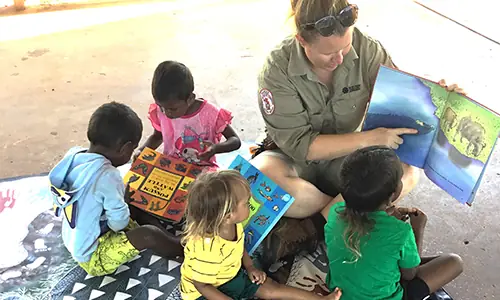
Early iterations of Be Crocwise focused on youth engagement, signage and broad-scale advertising. The modern approach incorporates feedback from stakeholders, experts, coronial enquiries and behavioural psychology, using these insights to inform the development of locally relevant programming suited to a diverse range of audiences.
Be Crocwise in Australia brings together decades of experience and learning. In recent years, international agencies have drawn on the campaign’s messaging and resources to develop programs tailored to their own contexts. Countries as varied as Singapore, the United States, Timor-Leste and, more recently, South Africa have implemented public safety initiatives inspired by this model.
Resources have been translated into languages such as Tetun in Timor-Leste and Yolŋu Matha in Eastern Arnhem Land, and there are now plans to produce locally relevant materials in isiZulu for use in the KwaZulu-Natal, Mpumalanga and Limpopo provinces in South Africa.
The Be Crocwise team in the Northern Territory has been proud to support these efforts as a trusted partner, sharing knowledge and expertise to help communities around the world safely coexist with crocodiles.